
Fake News in Fifth-Generation Warfare: The "Esmail Qaani" Model

By: Ashraf Gaber - The Editor-in-Chief
This article is part of a detailed strategic report that Defence MEA will publish tomorrow, Monday, God willing.
With the increasing complexity of the geopolitical situation currently sweeping the Middle East, modern warfare transcends traditional battlefields to reach the minds and convictions of the masses via cyberspace. "Information" is no longer merely a carrier of news, but has become a lethal strategic weapon in itself within the arsenal of fifth-generation warfare and psychological operations (PsyOps).
At Defence MEA magazine, we fully realize that our responsibility is not limited to monitoring military movements and defense deals; it extends to protecting the "strategic awareness" of our regular and specialized readers. In this article, we provide you with a simplified analytical guide to dismantle misleading narratives and black propaganda. Tomorrow, we will publish the full report, which may be more suited for researchers, specialists, and those interested in military affairs. National security, at its core, begins with information security.
Recently, with the escalation of regional conflicts—specifically the American-Israeli war against Iran—dramatic, anonymous claims, or those attributed to unverified sources, have surfaced. This raises a fundamental question: How can the follower and the specialist distinguish between truth and systematic disinformation? This requires employing analytical mechanisms to detect fake military news.
Among these is Assessing Reliability: Beware of the "Catchy Names" Trap. Disinformation campaigns often rely on creating pages or accounts with official-sounding names (such as fake news agencies). Strategic military news is not exclusively issued via unverified social media accounts before being confirmed by international news agencies or official military spokespersons.
As well as Analyzing Discourse and Timing. Official military statements are characterized by being dry, precise, and using direct, emotionless language. News that relies on excessive sensationalism or crowds chronologically and geographically distant details into a single event is mostly propaganda.
Esmail Qaani and American POWs: Two Models from the Battlefield
The following two models represent examples of the war of rumors and information during the current crisis:
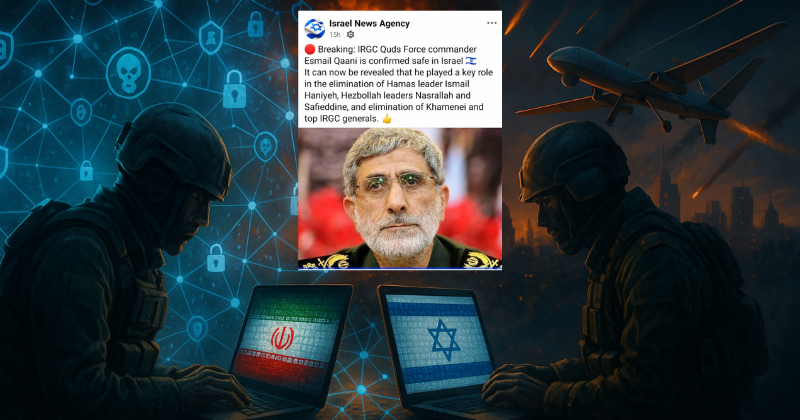
The Case of Esmail Qaani (Commander of the Quds Force): With rising tensions and a series of assassinations targeting prominent leaders in Iran, systematic rumors spread across unofficial accounts, such as the so-called "Israel News Agency" on social media platforms. These rumors claimed Qaani had defected and was in Israel, even alleging he orchestrated the assassinations of pivotal figures like Ismail Haniyeh and Hassan Nasrallah.
Analysis: This model represents a classic application of "black propaganda." It exploits the figure's temporary tactical absence from the scene to weave a fictional narrative that contradicts the complex ideological and command structure of the Revolutionary Guard. The strategic goal here is not to convince the elite, but to create a psychological rift, sow doubt, shake confidence among regional alliances (the Axis of Resistance), and attempt to project an unrealistic, comprehensive intelligence breakthrough.
The Counter-Model: The POWs Card and Pressuring the Home Front: The information war is not limited to one side. A prominent example of counter-tactics is the recent statement by "Ali Larijani," Secretary of the Iranian Supreme National Security Council, citing reports about the Iranian forces' success in "capturing" several American soldiers. He accused Washington of hiding the truth and promoting misleading narratives about their deaths in accidental incidents.
This statement represents a "surgical" psychological attack directly targeting the American home front. The term "Prisoner of War" (POW) has a seismic impact and extreme sensitivity among the American public and soldiers' families, sometimes exceeding the announcement of fatalities. The Iranian goal here is to fuel questions about the US administration's transparency, and to create a state of anger and internal popular pressure to halt operations.
In response, US Central Command (CENTCOM) realized the danger of this psychological trap. It rushed to activate anti-disinformation protocols through categorical denial and proactive transparency in announcing casualties, accusing the Iranian leadership of "systematic lying" and fabricating fake victories to boost the collapsing morale of its forces. This illustrates how the speed and accuracy of a response are the cornerstones of aborting a strategic rumor before it spreads.
Furthermore, the digital space is witnessing what can be called the Tactical Employment of Artificial Intelligence (Deepfakes). We have recently seen intensive use of AI-generated audio and video clips of political and military leaders, either to announce a fake surrender or to issue fake orders to withdraw from the fronts. This tactic relies on the "Shock and Awe" of the first moment before technical verification teams have the chance to refute it.
As well as the Recycling of Old Footage. This happens almost daily, with the publication of videos showing missile strikes or tank destruction from previous conflicts (like the Caucasus war or Syria), claiming they are live scenes from the currently burning fronts in the Middle East, with the aim of visually inflating casualties or justifying a counter-escalation.
Conclusion: In a complex and rapidly fluctuating security environment, critical awareness remains the first line of defense. Behind every piece of fake news stands an entity seeking to achieve a field or political gain, and understanding the "motive" dismantles half the narrative.
Comments (0)
No comments yet. Be the first to comment!