
Man of the week | Pedro Sánchez, Prime Minister of Spain

By: Ashraf Gaber
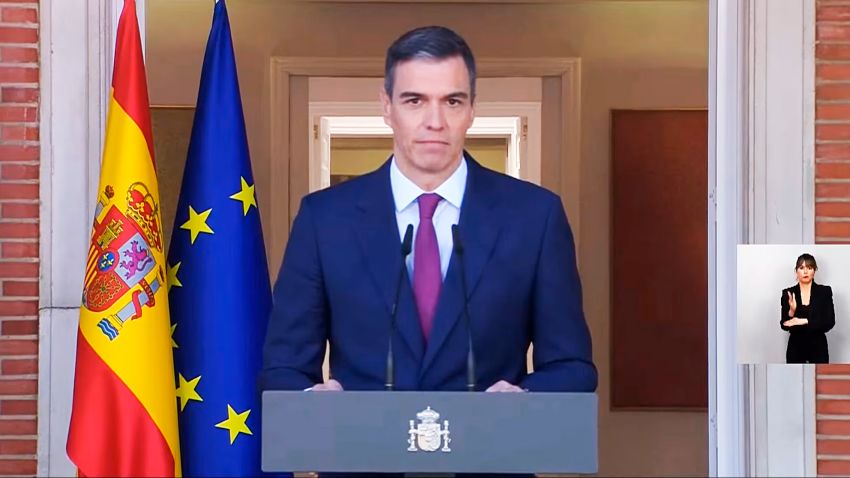
Before a week that buzzed with misery and opportunism on the international stage had ended a week in which most world leaders (reluctantly) tried to sit on the fence, Spain’s prime minister, Pedro Sánchez, chose a different path. He publicly rejected any Spanish participation in the American‑Israeli military escalation against Iran and barred any logistical use of Spanish bases, delivering a terse, decisive slogan: “No to war.”
This stance, crystallized in a televised address yesterday, Wednesday, was not merely a response to a request for military support; it was a declaration of strategic sovereignty that defines the limits of Spanish involvement in conflicts his government does not consider to serve national or legal interests.
The most concrete decision was to refuse permission to use the joint bases at Rota and Morón — bases that, according to President Donald Trump, he would not need Spain’s consent to use (though he claimed he would not). That refusal appears to follow a legal, security and diplomatic assessment concluding that any direct involvement could drag Europe into an endless cycle of escalation and expose its bases and ports to immediate danger.
Washington’s reaction was swift and sharp: the U.S. president threatened to cut trade ties with Spain, placing Sánchez before a stark test — preserve tangible economic interests or defend an ethical‑legal choice and refuse to make Madrid complicit in a dangerous escalation. Sánchez did not back down. He reiterated that Spain “will not be complicit” in a decision he believes violates the principles of international law and risks millions of lives. The clash between Madrid and Washington has reopened a larger question: to what extent can other European states, great powers, or countries worldwide exercise strategic autonomy when security and economic interests collide?
To understand this stance, one must connect it to a broader line of argument Sánchez has been building in recent months. At the Munich Security Conference (14 February 2026), Sánchez articulated a European vision grounded in international law and the containment of an arms race, warning against a return to nuclear competition and insisting that military solutions are no substitute for organized diplomacy. His Munich speech was not mere rhetoric; it was a strategic declaration of intent that helps explain his later refusal to participate in strikes that could trigger a wide regional escalation.
Sánchez does not treat foreign policy in isolation from domestic concerns. At the World Governments Summit in Dubai, he presented a hard line on social platforms and “Big Tech,” going so far as to describe the digital space as at risk of becoming a “failed state” if algorithms are left unchecked. He announced legislative measures to protect minors and democratic processes from algorithmic manipulation. This dimension casts Sánchez as a leader who links national security to digital governance, offering an integrated policy model: external independence paired with internal protections for civil society and institutions.
The impact of this stance plays out on several levels. First, in Europe, Madrid’s decision could embolden governments seeking paths independent of Washington on matters of war and peace, reopening debate about the European Union’s capacity to craft a unified foreign policy rooted in international law. Second, diplomatically, Spain faces a temporary confrontation with the United States that may cost part of its trade or invite political pressure, yet it gains credibility among European and global audiences demanding diplomatic solutions. Third, domestically, the move reinforces Sánchez’s image as a leader willing to assume political and economic risks in defense of his principles.
Designating Pedro Sánchez as “Man of the week” here is less a personal accolade than recognition of a political moment in which a European state made a clear decision to refuse participation in what it deems an unlawful war. Sánchez’s stance this week is a reminder that sovereignty and adherence to international law remain potent instruments in politics, and that an ethical, reasoned “no” can be stronger than any “yes” born of fear or short‑term interest.
Comments (0)
No comments yet. Be the first to comment!