
The Middle East Between Forced Integration Pathways and the Prospect of Regional Cohesion

By: Ashraf Gaber
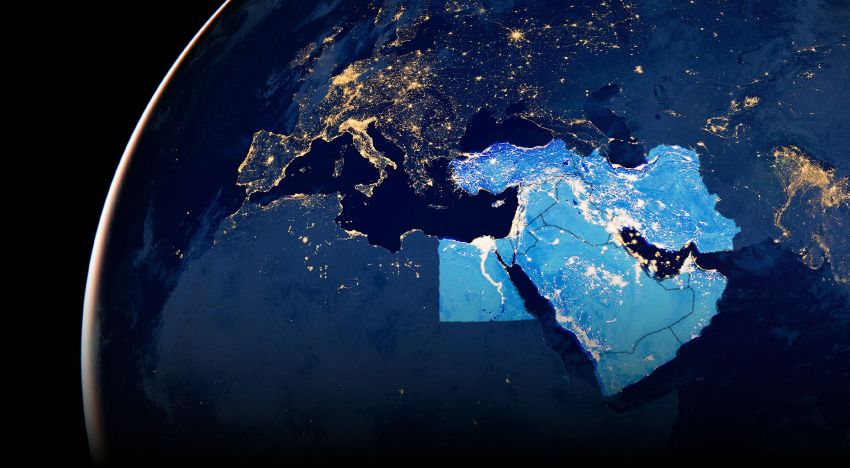
Today, the Middle East stands on the threshold of profound geopolitical transformations. The repercussions of the (Iranian-Israeli/American) conflict are imposing a new reality, placing the countries of the region at a historic crossroads.
In moments of major transition, maps of influence and alliances are reshaped, and scenarios are proposed that will outline the coming decades. A careful reading of the post-war trajectories reveals two parallel paths: one appears to be engineered to be imposed as a fait accompli, while the other represents an autonomous strategic choice aimed at correcting the region's course toward sustainable stability.
The First Scenario: Engineered Alliances and "Semi-Compulsory" Integration
The first scenario, the features of which are crystallizing in Western decision-making corridors, revolves around reshaping the security and political environment of the region by integrating the Gulf states into a new framework. This framework is based on two intersecting tracks:
- A Political-Economic Relationship with Israel: Aimed at bypassing historical conflicts by creating intertwined economic interests that normalize relations and make them a lived reality.
- A Security-Economic Relationship with the United States: Designed to ensure Western security superiority and provide a protective umbrella that makes the countries of the region structurally dependent on Washington.
This scenario seems like a "compulsory" path dictated by the fallout of the war, where security vacuums, regional polarization, and international pressures are exploited to push the Gulf states toward this alliance under the pretext of containing continuous threats. However, this path, despite the short-term tactical guarantees it may provide, entrenches regional division and holds the region hostage to permanent international geopolitical tensions.
The Second Scenario: The Strategic Choice and Correcting the Regional Compass
In contrast to the imposed integration path, a superior strategic choice emerges, rooted in the principle of a "structural correction" of the flawed regional situation. The region cannot stabilize amidst perpetual polarization; therefore, the supreme interest necessitates moving towards building stable strategic relations between the Gulf states and Iran.
Shifting from a "conflict management" mindset to one of "partnership building" requires an objective vision broad enough to encompass major regional powers. Hence, there is a pressing need to build a regional framework for cooperation and partnership comprising four main pillars: the Arab Gulf (primarily Saudi Arabia and the UAE), Iran, Egypt, and Turkey. This bloc is not directed against anyone; rather, it is a strategic repositioning that protects the region from foreign interventions and safeguards its resources.
Tremendous Potential and a Promising Future
A quick glance at the combined capabilities possessed by this bloc (the Gulf, Iran, Egypt, and Turkey) reveals a geoeconomic and geopolitical force capable of altering global balances of power:
- Energy Security and Trade Routes: These nations control the lion's share of global energy reserves (oil and gas) and command the most critical waterways and strategic straits (Hormuz, Bab el-Mandeb, the Suez Canal, and the Bosphorus).
- Demographic Mass and Markets: A massive human force representing a huge consumer market, alongside young human resources capable of leading an industrial and technological revolution in the region.
- Integration of Capabilities: Gulf financial surpluses can integrate with the industrial, agricultural, and human capacities of Egypt, Turkey, Iran, and perhaps Jordan—and later other countries—to create an independent and sustainable developmental model.
Directing this enormous potential toward development, economic prosperity, and joint infrastructure projects is sufficient to pull the region out of the quagmire of civil and proxy wars into the ranks of major economic blocs.
The Position of Palestine and Israel in the New Regional Order
This future-oriented, integrative vision does not exclude any party that adopts peace and good neighborliness. In this context, the doors of this developmental bloc remain open for Palestine and Israel to join, but based on an objective condition: the recognition of the two-state solution and the establishment of an independent, viable Palestinian state.
The integration of Israel into the fabric of the region cannot be imposed from above through American political engineering that ignores rights and the deep roots of the conflict. Instead, it must be the natural outcome of a just and comprehensive peace that restores rights to their rightful owners. Only then can an integrated economy and shared development serve as the true guarantor of stability and prosperity for all peoples of the region, including the Palestinian and Israeli peoples.
Ultimately, the Middle East is not merely a chessboard on which superpowers move their pawns according to their whims. The countries of the region, led by the quadrilateral bloc (the Gulf, Iran, Egypt, and Turkey), possess enough weight to chart their own future through self-determination. Choosing the path of regional integration and prosperity over the path of dependency and compulsory integration is the true historical test of the intelligence and will of political leaders at this pivotal juncture.

Comments (0)
No comments yet. Be the first to comment!